



The California Aquaculture Association is proud to share a series of perspectives from intern, Briana (Bri) Le, a fourth-year Aquatic Biology major and Professional Writing minor at UC Santa Barbara. Follow along as Bri explores the vital role of aquaculture for both consumption and conservation in her series “Bri’s Outlook on Aquaculture”.
During a meeting with my PI at the time, I asked her a question that randomly popped into my mind: was it possible to farm horseshoe crabs for their blood?
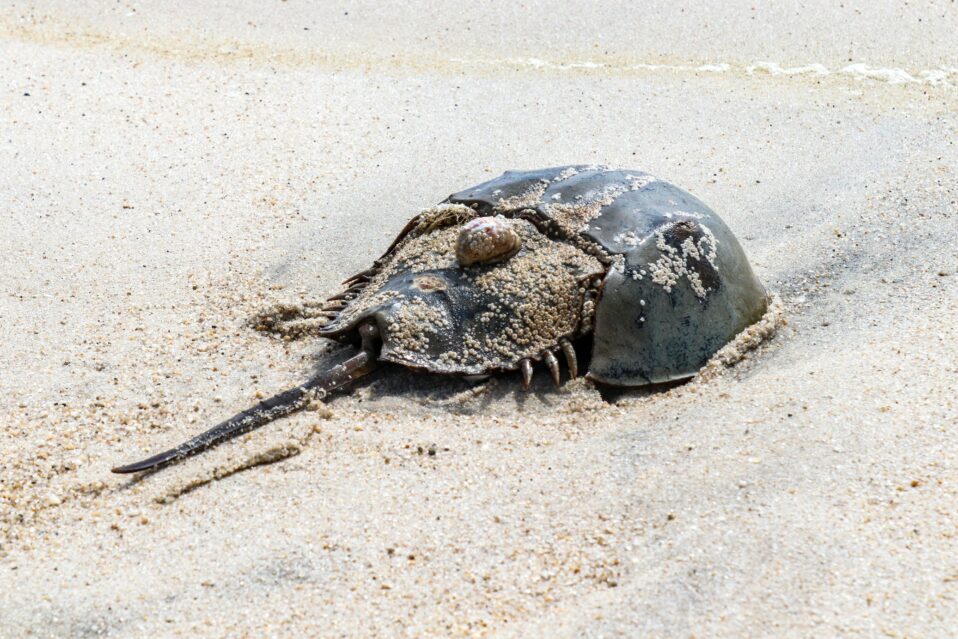
I’m not as interested in medicine as I am with seafood, but I learned that their blue blood was important in modern medicine. It was also brought to my attention that the Atlantic horseshoe crab (Limulus polyphemus) is considered vulnerable by the IUCN, largely due to overharvesting and climate change. If we rely on horseshoe crabs for their blood, shouldn’t we consider farming them to reduce pressure on wild populations?
My PI responded that raising horseshoe crabs in a captive and controlled environment wasn’t really feasible because crabs are inherently prone to cannibalism. Despite the consistent high demand for crab meat globally, it wouldn’t be practical to farm them. Crab cannibalism—a naturally occurring response when food and space are limited—is one of the major reasons why we don’t see many crab aquaculture operations. Not only does it directly decrease the population, but crab cannibalism can also spread pathogens and diseases that would be difficult to address in a concentrated captive population.
That’s not to say that crab aquaculture doesn’t exist! There are several farming operations in Asia, Australia, and Africa that primarily culture mud crabs (Scylla spp.). Mud crabs are farmed both extensively (i.e., lightly managed and reliant on natural ecosystems) and intensively (i.e., heavily managed and reliant on closed systems). For instance, farmers have raised crabs in flooded rice paddies; crabs help control pests and fertilize the soil, resulting in efficient yields of both rice and mud crabs. Farmers have also implemented vertical box farming, where mud crabs are raised in individual boxes stacked on top of each other to maximize space and meat yield.
Though this discussion is not focused on mud crab farming, I still wanted to determine the viability of farming horseshoe crabs, especially if it could contribute to their wild populations and supply of blue blood.
Horseshoe crabs are fascinating organisms, first appearing in the ocean approximately 450 million years ago. They predate dinosaurs by more than 200 million years, and they remain largely unchanged. These ancient marine arthropods are not true crabs, nor are they crustaceans; they’re more closely related to spiders and scorpions! At some point in human history, researchers discovered a unique property in their blood that changed the medical field for good.
Their blood is blue because of copper-based molecules, unlike iron-based hemoglobin in our red blood. Specialized immune cells called amebocytes are in their blue blood, which rapidly reacts by clotting in the presence of bacterial toxins, referred to as endotoxins. This clotting is vital in determining whether the tested drug or medical device was contaminated with a dangerous pathogen. A test centered around this blood-clotting mechanism, known as Limulus Amebocyte Lysate (LAL), became the standard for pharmaceutical quality testing. Every single medical product that introduces medicine into the bloodstream (e.g., vaccines, IV bags, injectable medication) has most likely been through LAL testing to ensure safety. If you’ve ever received a vaccine or IV, horseshoe crab blood has contributed to your health.
However, producing LAL is problematic. Each year, countless horseshoe crabs are harvested from coastal waters, transported to biomedical facilities, where they’re bled, and their blood is collected in glass jars. Up to 30% of their blood volume is extracted through a needle inserted near their heart. They are then returned to the ocean; many experience stress and mortality post-release. At least half a million horseshoe crabs are killed each year. They are also essential to coastal ecosystems: their eggs help supply energy for migrating shorebirds, and their burrowing behavior aerates the sand, which creates a more suitable environment for other sandy invertebrates. A declining horseshoe crab population is devastating to coastal ecosystems, particularly beaches.
Circling back to my question: why not just farm them? Aside from cannibalism, horseshoe crabs are slow growers, taking 9 to 12 years to reach reproductive maturity. If an aquaculture farm wanted to raise horseshoe crabs through a hatchery, it would take nearly a decade to produce any product. Considering the slow growth rate, cannibalism, and high operating costs, farming them would simply not be profitable.
Even if horseshoe crab farming isn’t feasible, this discussion highlights the possibilities and limitations of aquaculture. Successful aquaculture operations depend on understanding the species’ behavior, life history, environmental needs, and economic viability.
The ethical and environmental concerns surrounding horseshoe crabs also reflect a broader objective shared across aquaculture and conservation: meeting human needs without compromising wild populations and ecosystems. Whether through sustainable farming practices or the development of synthetic alternatives to LAL, innovation will play an important role in protecting organisms, such as the ancient horseshoe crab. Sometimes aquaculture can be the solution, but sustainability also begins with recognizing that conservation must take priority.
#
About the Author
Briana (Bri) Le is a fourth-year Aquatic Biology major and Professional Writing minor at UC Santa Barbara, where she focuses on the Science Communication Track. A first-generation college student and Vietnamese-American, Bri is a member of the McNair and FUERTE fellowships, programs dedicated to helping students from underrepresented backgrounds develop research and professional skills. Her background includes studying the thermal tolerance of juvenile giant kelp under Dr. Halley Froehlich and completing a hands-on internship at The Cultured Abalone Farm in Santa Barbara, where she gained practical experience in land-based farm operations.
Driven by a passion for ‘practical science’, Bri aims to bridge the gap between complex marine research and public understanding. She views aquaculture as a cornerstone of global food security and environmental conservation, yet recognizes that it remains widely misunderstood. Through her work with the California Aquaculture Association, Bri uses her communication skills to demystify the industry and promote diversity, striving to make the field more accessible and inclusive for people of all backgrounds.
Recent Comments