



The California Aquaculture Association is proud to share a series of perspectives from intern, Briana (Bri) Le, a fourth-year Aquatic Biology major and Professional Writing minor at UC Santa Barbara. Follow along as Bri explores the vital role of aquaculture for both consumption and conservation in her series “Bri’s Outlook on Aquaculture”.
From 2013 to 2017, the California coast experienced abnormally high sea surface temperatures. This phenomenon, dubbed ‘The Blob,’ had detrimental effects on marine ecosystems in the Pacific Ocean. Kelp forests were especially vulnerable to the impacts of increasing ocean temperatures, also known as a marine heatwave.
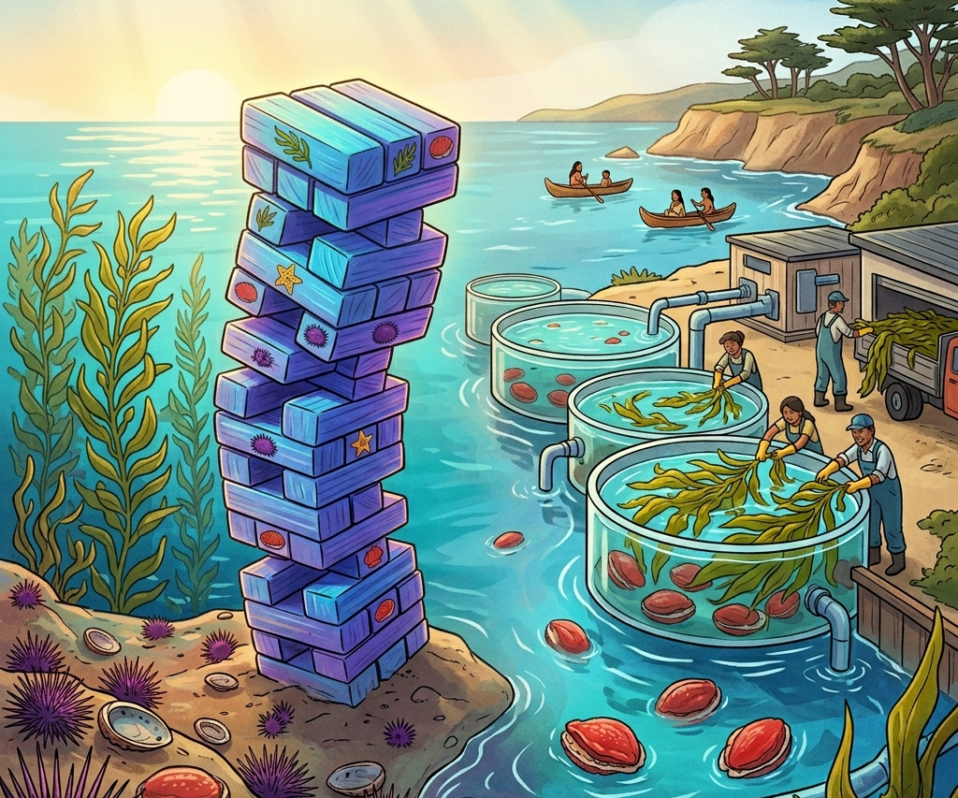
Picture a Jenga tower stabilized and supported by wooden blocks. Each block represents a species responsible for upholding the ecosystem, which in this case is the kelp forests along the California coast. The Blob removed many blocks from the tower, causing it to topple over, and making it difficult for the tower to be restored naturally.
Essentially, the Blob caused a large decline in giant kelp as they cannot tolerate the hotter temperatures. Purple sea urchins could freely graze on kelp as their predator, the sunflower seastar, was wiped out by a sea star wasting disease that was worsened by the heat. These purple sea urchins eventually overgrazed the kelp forests, leaving rocky urchin barrens with no kelp behind. This proved problematic for many marine species residing in kelp forests.
One of those species is the red abalone, a large mollusk or sea snail. Red abalone are prized for their sweet-tasting meat and iridescent shell. They were heavily harvested from kelp forests for decades, with the commercial fishery reaching its peak landings in the 1950s. With the combined effects of The Blob, sea urchin barrens, and overharvesting, the red abalone’s population has rapidly declined. Commercial fishing of red abalone was closed in 1997, and recreational fishing was closed in 2017; the abalone fishery is to remain closed until further notice. So, where does California’s abalone come from now?
This is where aquaculture comes in. Abalone has been farmed in California since the late 1960s. Though farms were already operating, the recent fishery closures have caused a dramatic shift in their importance. A notable land-based operation is The Cultured Abalone Farm in Santa Barbara, CA, known for sustainably hand-raising red abalone.
The Cultured Abalone Farm doesn’t look like much from the outside. However, once inside, a person is met with rows of tanks, each filled with red abalone and fresh, running seawater. These tanks are divided into sections by life stage and size. The operation has a hatchery housing larval abalone, juvenile tanks, and larger grow-out tanks where they slowly grow toward market size.
On feeding days, workers have to haul loads of giant kelp from the back of a truck into a wheelbarrow to distribute the kelp by hand into the tanks. Sticky slime from the kelp would get onto their gloves, shirts, and pants. Finished with feeding the abalone, workers carried the briny smell of kelp for the rest of the day. The animals eat, grow, and are tended to by a small, hard-working crew.
The slowness is a defining reality of abalone farming. Red abalone have a slow growth rate, taking three to four years to reach market size. Each abalone raised is a long-term investment that demands patience, care, and diligence. The result is a premium product, hand-raised and carefully managed from hatchery to harvest.
Not only is farmed abalone filling a market gap, but it’s maintaining a cultural and culinary significance in California during a critical period of wild population recovery. That said, farmed abalone is expensive, which is reflective of the consequences of overharvesting a slow-growing species. Abalone also has deep significance for California coastal communities, especially for Indigenous communities, such as the Chumash and Kumeyaay, who harvested them long before commercial fisheries existed. With no set date for when abalone fisheries reopen, aquaculture’s significance won’t decrease anytime soon. It’s a slow process, but then again, so is raising abalone.
#
About the Author
Briana (Bri) Le is a fourth-year Aquatic Biology major and Professional Writing minor at UC Santa Barbara, where she focuses on the Science Communication Track. A first-generation college student and Vietnamese-American, Bri is a member of the McNair and FUERTE fellowships, programs dedicated to helping students from underrepresented backgrounds develop research and professional skills. Her background includes studying the thermal tolerance of juvenile giant kelp under Dr. Halley Froehlich and completing a hands-on internship at The Cultured Abalone Farm in Santa Barbara, where she gained practical experience in land-based farm operations.
Driven by a passion for ‘practical science’, Bri aims to bridge the gap between complex marine research and public understanding. She views aquaculture as a cornerstone of global food security and environmental conservation, yet recognizes that it remains widely misunderstood. Through her work with the California Aquaculture Association, Bri uses her communication skills to demystify the industry and promote diversity, striving to make the field more accessible and inclusive for people of all backgrounds.
Recent Comments