



The California Aquaculture Association is proud to share a series of perspectives from intern, Briana (Bri) Le, a fourth-year Aquatic Biology major and Professional Writing minor at UC Santa Barbara. Follow along as Bri explores the vital role of aquaculture for both consumption and conservation in her series “Bri’s Outlook on Aquaculture”.
The crisp morning air smelled slightly briny as I walked through the Santa Barbara Harbor. Seabirds glided through the sky in search of their next meal, and seeing the rows of sailboats evoked a peaceful feeling. But I came to the harbor in search of something specific.
This was also a Saturday morning, which means the Fishermen’s Market is happening on the harbor. I approached a tent selling live sea urchins, where I was told the sea urchins from Santa Barbara were exceptionally delicious. Curious, I went to try them for myself.
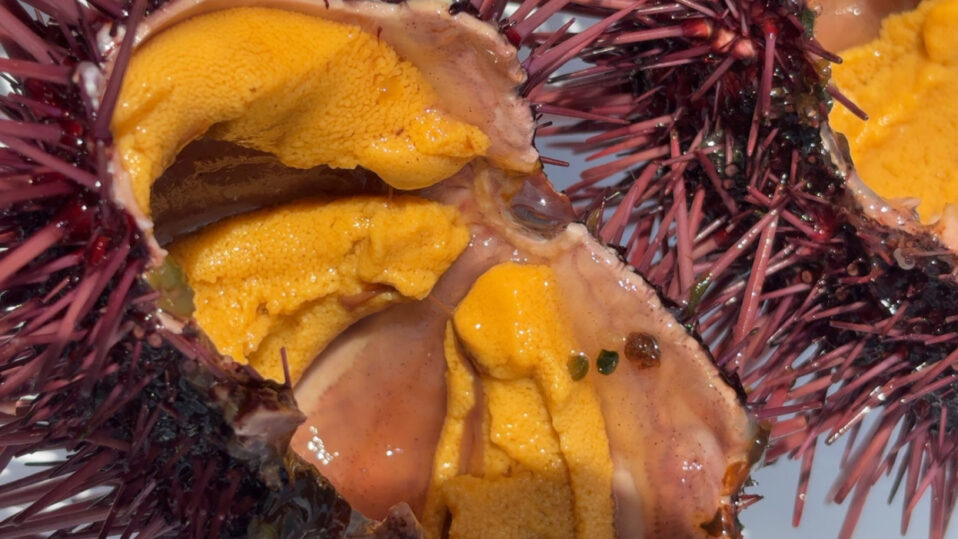
I bought a single urchin. Served on a paper tray, the urchin was cracked in half and ready to eat. The gold-colored uni lined the inside of the exoskeleton, and long spikes covered the outside. It was a bit intimidating at first—it’s not often I come across a spiky sea urchin. I delicately dug my spoon into the urchin, scooping up a portion of uni, which I then placed in my mouth, unsure what to expect.
It was absolutely delicious. Santa Barbara’s uni was like nothing I had ever tasted. This soft, delicate gonad was rich and creamy. The taste was briny, yet sweet and umami. The uni melted on my tongue, coating my taste buds with this exquisite flavor. I have been an avid enjoyer of uni since then.
So, what is uni? Essentially, it’s the gonads of sea urchins. Urchins don’t have much in them, so they’re only sought after for their gonads. For those who don’t know what a sea urchin is, they’re herbivorous marine invertebrates covered all over in spikes that graze on algae in kelp forests. They’re related to sea stars and sand dollars. It makes me wonder how uni was found—who in their right mind cracked open this spiky animal and thought that this yellow clump was good to eat? And yet, here we are, grateful for whoever was brave enough to find out.
In recent years, purple sea urchins have been problematic for kelp forests. With the combination of marine heatwaves and loss of natural predators (e.g., sea otters, sea stars, and large fish), it was inevitable that the sea urchin population would rapidly increase. Urchins relentlessly graze along the seafloor for algae with an endless appetite. Sea urchins will continue to feed on algae until there is none left to eat, and they will not die from starvation. Instead, they will enter a zombie-like state, surviving for years without any food available.
Kelp forests are important ecosystems, supporting vast marine biodiversity and fisheries targeting species residing in this habitat. So, how can we help control the urchin population so they don’t wreak havoc on the kelp forests? One answer: by eating them.
Currently, the only way for sea urchins to be harvested is through diving or foraging. This is also part of why uni is sold at a premium price. They’re primarily hand-picked, as it’s not possible to reel them out of the water, so they are labor-intensive to harvest.
That said, aquaculture has been helping to address the purple sea urchin issue. A few farms have turned to sea urchin ranching. Urchin ranching is where divers harvest an abundance of starved urchins from the ocean and place them in a controlled land-based facility. There, sea urchins are fed a constant supply of kelp until they develop high-quality uni. It’s similar to a livestock farmer having their cattle graze on fresh, premium grass until they’re ready to be processed for meat.
Though urchin ranching is not an overarching solution to the zombie urchin crisis, it is a method that benefits many who are involved in the process. Sea urchin divers profit from their harvested urchins. Aquaculture farms earn income from selling their ranch-raised urchins. Consumers receive a sustainably-sourced, high-quality product. And, most importantly, the kelp forests have an opportunity to recover with fewer urchins present. There is no reason not to eat sea urchin if you have the means to.
Sea urchins are seen as the destroyer of kelp forests. But we have to remind ourselves that urchins have always been residents of kelp forests, and natural predators have kept their numbers in check until there were none present. You can support your kelp forests by eating locally sourced sea urchins. The same animal causing the problem might be part of the solution. It might also be your next delicious meal.
#
About the Author
Briana (Bri) Le is a fourth-year Aquatic Biology major and Professional Writing minor at UC Santa Barbara, where she focuses on the Science Communication Track. A first-generation college student and Vietnamese-American, Bri is a member of the McNair and FUERTE fellowships, programs dedicated to helping students from underrepresented backgrounds develop research and professional skills. Her background includes studying the thermal tolerance of juvenile giant kelp under Dr. Halley Froehlich and completing a hands-on internship at The Cultured Abalone Farm in Santa Barbara, where she gained practical experience in land-based farm operations.
Driven by a passion for ‘practical science’, Bri aims to bridge the gap between complex marine research and public understanding. She views aquaculture as a cornerstone of global food security and environmental conservation, yet recognizes that it remains widely misunderstood. Through her work with the California Aquaculture Association, Bri uses her communication skills to demystify the industry and promote diversity, striving to make the field more accessible and inclusive for people of all backgrounds.
Recent Comments