



California has always known how to grow.
We grow food, ideas, technology, talent, brands, movements, and markets. We are known around the world for agriculture, innovation, coastal resources, environmental leadership, culinary influence, and the ability to turn possibility into something people recognize, buy, taste, and believe in.
So why not aquaculture?
That is the question worth asking.
Across the United States, aquaculture looks different depending on where you stand. In Mississippi, it looks like catfish ponds and a strong agricultural identity. In Idaho, it looks like trout production built around the cold, clean spring water of the Magic Valley. In Washington, it looks like shellfish culture deeply connected to coastal waters and working waterfronts. In Maine, it looks like oysters, mussels, seaweed, salmon, small farms, training programs, and coastal communities building a modern blue economy.
And in California?
California aquaculture looks like opportunity.
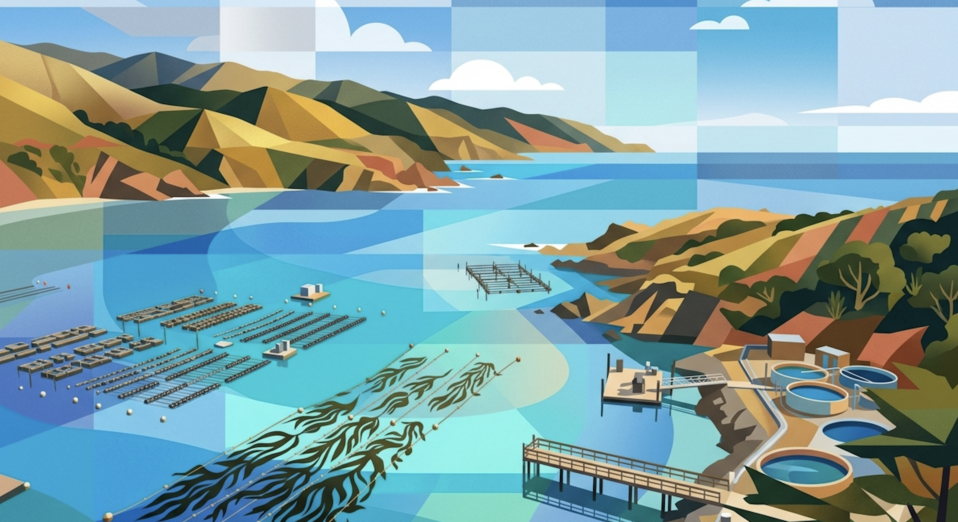
It is oysters, abalone, mussels, clams, trout, sturgeon, catfish, tilapia, striped bass, seaweed, hatcheries, restoration, research, technology, and coastal innovation. It is freshwater and marine. It is food and conservation. It is farms and labs. It is entrepreneurs, scientists, educators, producers, regulators, chefs, and communities all trying to understand where this industry can go next.
California is not starting from nothing.
But California is still defining its aquaculture identity.
That may be one of the biggest opportunities in front of us.
When we look at other states, the lesson is not that California should become Mississippi, Idaho, Washington, Maine, Louisiana, Florida, or Alabama. California has its own coastline, its own permitting environment, its own markets, its own environmental priorities, and its own public expectations.
But other states can teach us something.
Mississippi teaches us the power of identity. Catfish is not just a product there. It is part of the agricultural story. People understand it. They know where it comes from. They recognize the farms, the food, and the economic value. That kind of clarity matters. California aquaculture needs that same kind of public recognition, even if our species mix is more diverse.
Idaho teaches us the power of clustering. The trout industry in Idaho grew around natural resources, infrastructure, processing, workforce, feed knowledge, water management, and regional expertise. When farms, suppliers, processors, researchers, and trained workers are connected, an industry becomes easier to support and harder to ignore. California has the ingredients to build regional aquaculture clusters, especially around ports, harbors, research centers, hatcheries, inland systems, and coastal communities.
Washington teaches us the power of shellfish tradition and working waterfront visibility. Shellfish farming has a long history in the Pacific Northwest, and that history helps create familiarity. People may not understand every detail of how oysters, clams, mussels, or geoducks are farmed, but they know shellfish aquaculture belongs in the coastal food conversation. California has its own shellfish story, but we have more work to do to make it visible and understood.
Maine teaches us the power of community scale. Maine’s aquaculture growth has included small farms, younger workers, seaweed, shellfish, finfish, training programs, and a strong connection to coastal identity. The lesson from Maine is not just production. It is storytelling, local pride, workforce development, and the idea that aquaculture can be woven into the life of coastal and rural communities.
And then there is California.
California has something no other state has in quite the same way.
We have one of the strongest food cultures in the country. We have world-class universities. We have coastal and inland agriculture. We have chefs, farmers markets, seafood markets, ports, public aquariums, environmental organizations, technology companies, and consumers who already care about where food comes from. We have people who understand branding, traceability, sustainability, wellness, climate conversations, local food, and premium products.
Those are enormous advantages.
But advantages do not become progress by themselves.
California aquaculture faces real challenges. Permitting can be slow and expensive. Coastal space is complicated. Public understanding is limited. New farms can face uncertainty before they ever get into the water. Producers need clearer pathways, better coordination, stronger workforce pipelines, more market development, and more public education.
Those challenges are not reasons to shrink the conversation.
They are reasons to organize it.
If California wants to grow aquaculture responsibly, we need to help people understand what this industry actually is. We need to make aquaculture less mysterious and more visible. We need to show the public that aquaculture is agriculture. We need to explain the difference between species, systems, and production methods. We need to connect chefs and buyers to California-grown aquatic products. We need to help students see careers in the field. We need to support the producers already doing the work while helping create better pathways for the next generation.
We also need to study what is working elsewhere.
Could California use more harbor-led aquaculture models, where ports and harbors help create clearer pathways for new farms?
Could we develop stronger regional clusters around shellfish, seaweed, inland finfish, restoration, and hatchery work?
Could we build workforce programs that connect community colleges, universities, farms, hatcheries, and seafood businesses?
Could we make California-grown aquatic products more recognizable to consumers?
Could we help chefs, grocers, and foodservice buyers understand the value of local aquaculture?
Could we create a stronger bridge between policy, science, production, and markets?
The answer is yes.
But the work has to be intentional.
California aquaculture will not grow simply because the need is there. It will grow because producers, regulators, researchers, educators, buyers, and industry organizations decide to make the path clearer and the story stronger.
Other states show us what is possible when aquaculture has identity, infrastructure, coordination, and community support.
California can take those lessons and build something that fits here.
Something responsible. Something innovative. Something diverse. Something worthy of California’s food and environmental leadership.
This is not about trying to be like anyone else.
It is about recognizing that aquaculture is already part of America’s food future, and California has a real opportunity to help shape what that future looks like.
From oysters to abalone. From trout to sturgeon. From seaweed to shellfish. From hatcheries to harbors. From inland systems to coastal farms.
California aquaculture has a story worth telling and a future worth building.
Now the opportunity is to make sure more people can see it.
Recent Comments