



There was a time when “the future” looked like flying cars, robot maids, meals in capsules, and houses in the sky.
The Jetsons made everything look automatic, shiny, slightly ridiculous, and somehow believable.
And here we are, many years later, still not commuting in flying cars, but we are carrying tiny computers in our pockets, talking to artificial intelligence, using drones to monitor land and water, and asking machines to help us make better decisions faster.
So maybe the future did show up.
It just showed up wearing boots, gloves, waders, lab coats, hairnets, and maybe a little fish slime.
For California aquaculture, that future is not about replacing people. It is about giving people better tools.
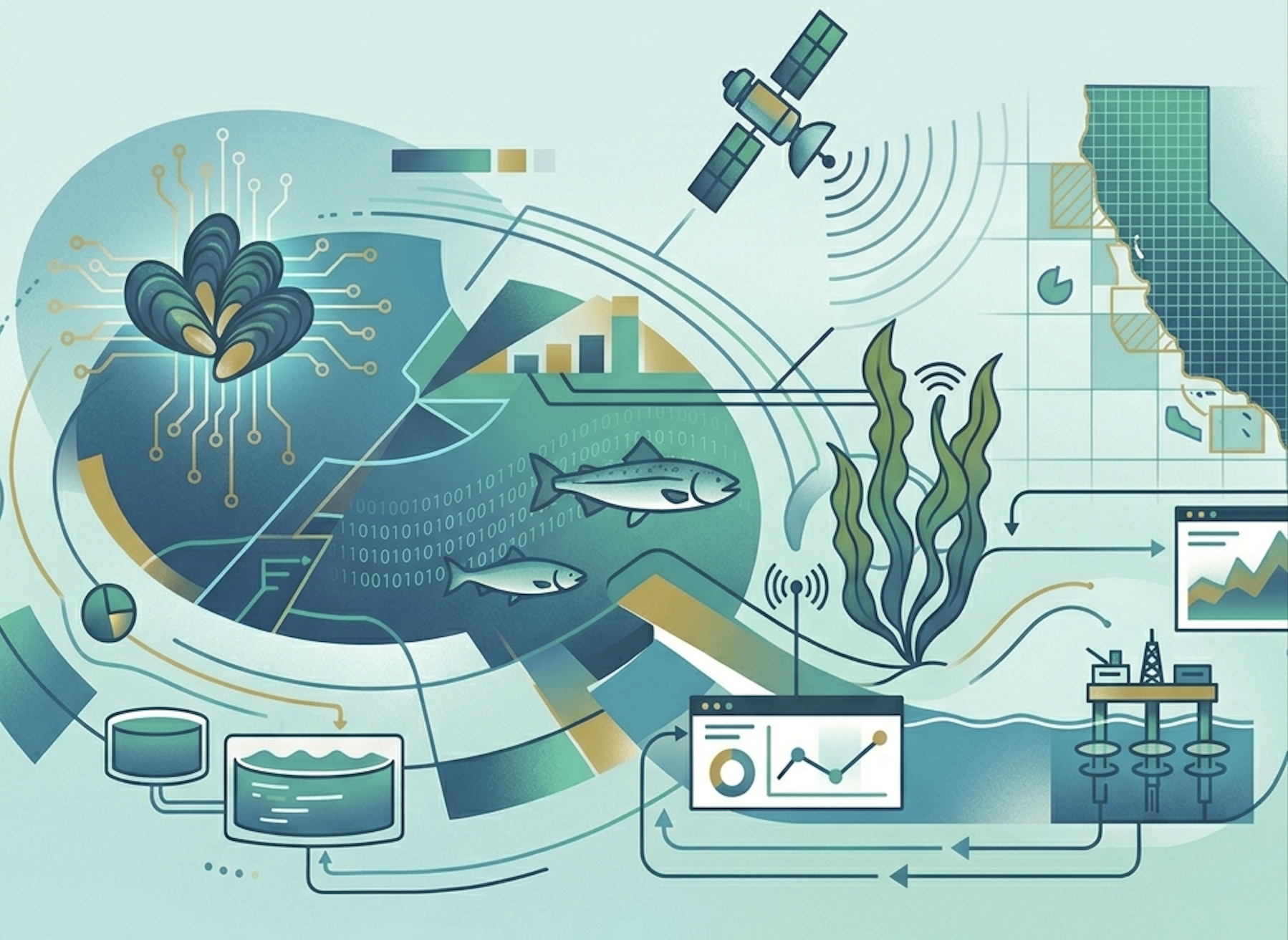
Imagine a shellfish farmer getting an early alert before water conditions shift. Imagine a trout or sturgeon producer seeing real-time changes in oxygen, temperature, feeding behavior, or water quality before a problem becomes a loss. Imagine hatchery teams using data to better understand survival, growth, and animal health. Imagine seaweed growers using mapping, sensors, and forecasting tools to better plan production. Imagine seafood buyers being able to trace a California-grown product from water to market with a story the consumer can actually understand.
That is not cartoon science fiction.
That is the direction aquaculture is already moving.
The “Jetsons” version of aquaculture is not a robot taking over the farm. It is a smarter farm, a more visible farm, and a better-connected farm. It is people using technology to protect animals, reduce waste, improve water use, strengthen food safety, support production decisions, and tell the story of California-grown aquatic products more clearly.
Because aquaculture has always been both biological and technical.
It is water, oxygen, feed, health, temperature, genetics, handling, filtration, nutrients, tides, weather, infrastructure, markets, and people. A lot has to go right. And when something starts to go wrong, timing matters.
That is where AI and new technology may become incredibly useful.
AI is very good at noticing patterns. It can look at large amounts of information and help identify what is changing, what is trending, and what may need attention. In aquaculture, that could mean earlier warnings, better forecasting, more precise feeding, stronger animal health monitoring, improved logistics, and smarter business planning.
For producers, that matters. For workers, that matters. For the future of the industry, that really matters.
California aquaculture includes oysters, mussels, clams, abalone, trout, sturgeon, catfish, tilapia, striped bass, seaweed, hatcheries, restoration work, and more. Each species and system has its own needs, but they all share one thing: they depend on people who understand living systems.
Technology will not change that.
It may actually make that human knowledge more valuable.
The future aquaculture workforce may need to understand water quality and data dashboards. Animal behavior and automated feeding. Food safety and traceability. Hatchery work and sensor systems. Farm operations and public communication. Biology and business. Science and storytelling.
That opens doors.
It creates new kinds of jobs and new kinds of career paths. It gives young people a way to see aquaculture as modern, skilled, science-based, technology-enabled, and meaningful. It helps the public understand that aquatic food production is not something hidden or mysterious. It is part of California’s food future.
And honestly, that is exciting.
Because the industry does not need technology for the sake of technology. It needs useful tools that help producers do what they already care about: grow healthy animals and plants, protect water, manage risk, produce food, support communities, and build businesses that last.
Maybe the future of aquaculture does not look like a cartoon city in the clouds. Maybe it looks like a shellfish farm with better forecasting.
A hatchery with smarter monitoring.
A recirculating system that can catch water quality changes earlier.
A seaweed farm mapped with precision.
A seafood box that tells the story of exactly where it came from.
A student who sees aquaculture and realizes, “There is a future for me here.”
That is the real opportunity.
Not a future without people.
A future where people have better tools, better data, better visibility, and better ways to grow.
So yes, maybe aquaculture could use a little Jetsons energy.
A little imagination.
A little innovation.
A little “what if?”
Because California aquaculture is not standing still.
It is growing, adapting, learning, and preparing for a future that may be closer than we think.
And if we get it right, the future will not just be more automated.
It will be more connected, more transparent, more resilient, and more full of opportunity.
That is a future worth building.
And maybe, just maybe, George Jetson would have loved a California-grown oyster.
Recent Comments