



The California Aquaculture Association is proud to share a series of perspectives from intern, Briana (Bri) Le, a fourth-year Aquatic Biology major and Professional Writing minor at UC Santa Barbara. Follow along as Bri explores the vital role of aquaculture for both consumption and conservation in her series “Bri’s Outlook on Aquaculture”.
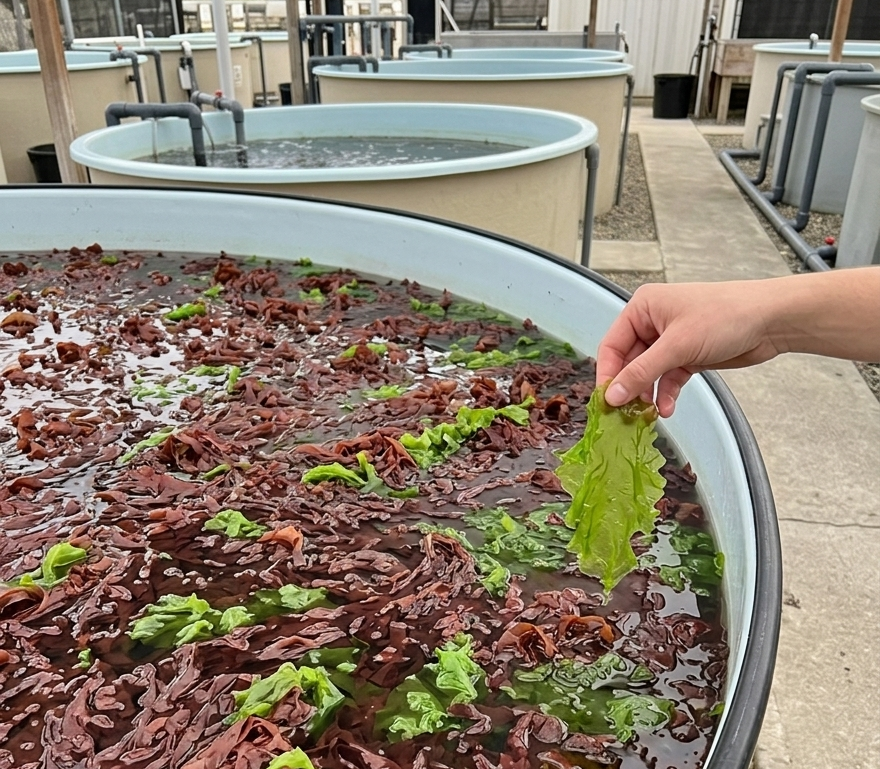
Not everything grown on an aquaculture farm is intentional. Sometimes it can pave the way for new opportunities. During my internship at The Cultured Abalone Farm in Santa Barbara, I noticed floating pieces of green algae circulating in a tank full of red dulse. The farm only cultures red seaweeds – ogo (Gracilaria pacifica) and dulse (Develerea mollis) – along with their red abalone and purple sea urchins. It was slightly odd to see some green seaweed among the red seaweed.
It was sea lettuce, otherwise known as Ulva spp., growing on its own. Knowing that it was edible, I grabbed a piece of sea lettuce and tasted it out of curiosity. The sea lettuce didn’t have much flavor, differing from the briny taste distinctive in other seaweeds. Although the flavor was subtle, the texture scratched a specific part of my brain that I did not know existed. The sea lettuce’s texture was thin and delicate, and it reminded me of eating a photography film. It’s an odd description for sea lettuce’s texture, but it worked for me and this revelation has stuck ever since.
So, what is sea lettuce? Ulva spp. is a bright green marine algae found along coastlines worldwide, including California. Sea lettuce is one of the most widespread green seaweeds, thriving in both rocky intertidal zones and brackish estuaries. Despite its abundance, many walk past this seaweed without much thought.
Interestingly, humans have eaten sea lettuce for centuries. With plenty of sea lettuce growing in accessible areas, people often forage it along the coast. It’s common in East Asian, British, and Scandinavian cuisines, typically eaten in soups, salads, and used as a garnish. Sea lettuce is also highly nutritious with numerous health benefits, boasting antioxidant and anti-inflammatory properties. It’s also high in protein, iron, fiber, and vitamins A and C. For sea lettuce being so overlooked in the United States, it has fed global communities throughout time.
Despite its benefits, there are mixed feelings on sea lettuce. In some coastal areas, sea lettuce blooms can rapidly grow, forming thick mats along the water’s surface. These algae blooms deplete oxygen levels in water and create dead zones, suffocating marine life. For many, sea lettuce is associated with problematic algae blooms rather than something appetizing. That perspective is difficult to change, even when the same algae causing issues in polluted waters are perfectly edible in clean waters. Given the right conditions and environment, sea lettuce can write an entirely different story.
That different story is already being written in California. There are efforts in researching the possibility of growing sea lettuce as a cultivated crop in aquaculture. One approach is through integrated multi-trophic aquaculture (IMTA), where multiple species are farmed together to represent natural ecosystems. Sea lettuce can absorb excess nutrients released by fish and shellfish, acting as a natural water filter.
Cultivated sea lettuce also has potential as a sustainable food source and ingredient in aquaculture feed. Replacing conventional feed ingredients with locally-sourced sea lettuce could reduce the environmental footprint of aquaculture operations in California. A few California farms and research institutions have been exploring this opportunity, such as Sunken Seaweed and Moss Landing Marine Laboratories. With the continuously growing interest in seaweed aquaculture, sea lettuce is becoming difficult to ignore.
Sea lettuce has always been present, quietly growing all over the coast of California. Considering its nutritional value, culinary uses, and position in sustainable aquaculture operations, sea lettuce deserves more than a passing glance.
Sometimes the most overlooked things deserve a bit more attention. All it takes is grabbing a piece from a tank and giving it a try.
#
About the Author
Briana (Bri) Le is a fourth-year Aquatic Biology major and Professional Writing minor at UC Santa Barbara, where she focuses on the Science Communication Track. A first-generation college student and Vietnamese-American, Bri is a member of the McNair and FUERTE fellowships, programs dedicated to helping students from underrepresented backgrounds develop research and professional skills. Her background includes studying the thermal tolerance of juvenile giant kelp under Dr. Halley Froehlich and completing a hands-on internship at The Cultured Abalone Farm in Santa Barbara, where she gained practical experience in land-based farm operations.
Driven by a passion for ‘practical science’, Bri aims to bridge the gap between complex marine research and public understanding. She views aquaculture as a cornerstone of global food security and environmental conservation, yet recognizes that it remains widely misunderstood. Through her work with the California Aquaculture Association, Bri uses her communication skills to demystify the industry and promote diversity, striving to make the field more accessible and inclusive for people of all backgrounds.
Recent Comments