



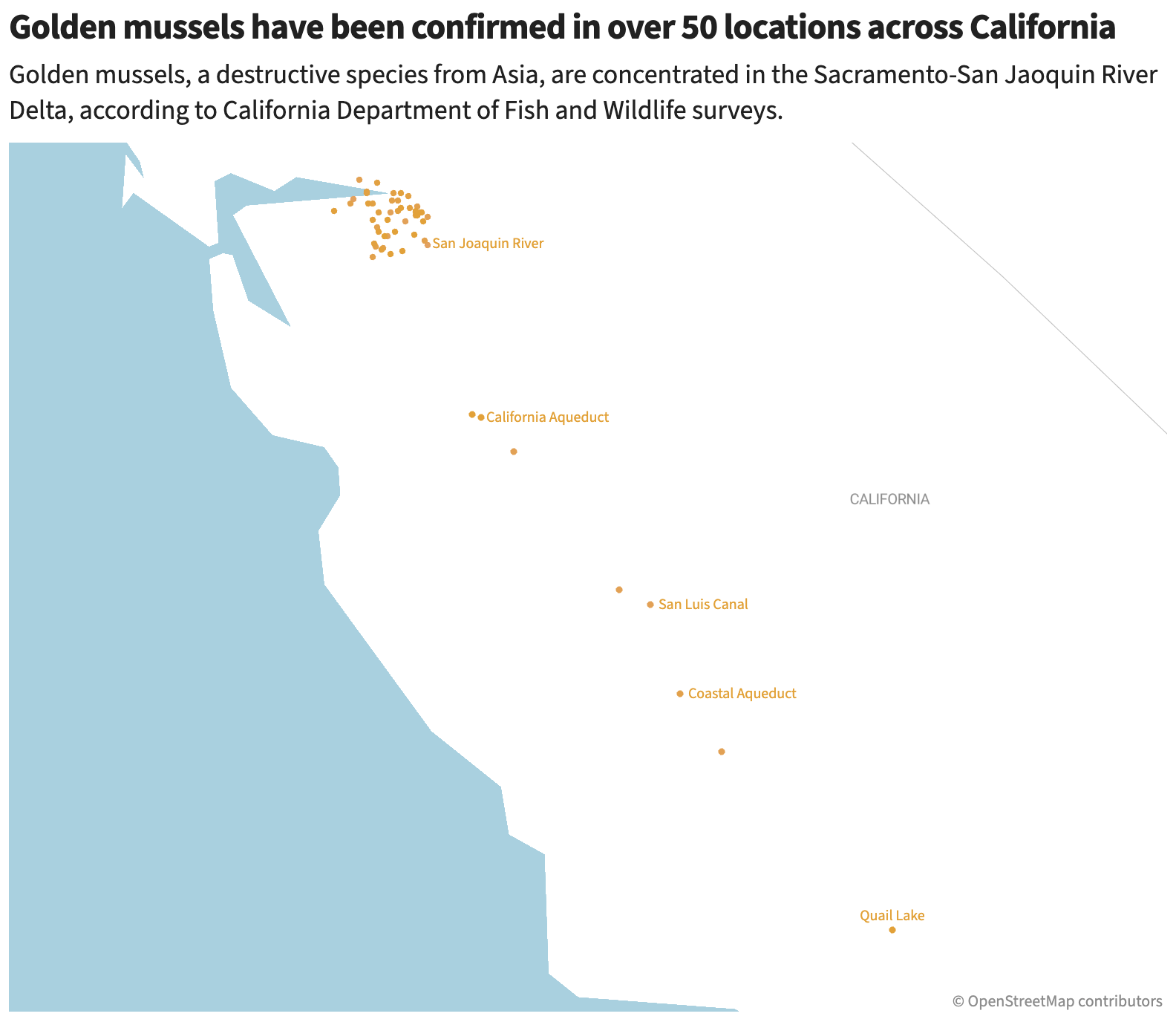
California is racing to contain the spread of golden mussels, an aggressive aquatic invader that has recently been detected in the heart of the state’s water system. First found encrusting a float near the Port of Stockton in the Sacramento-San Joaquin Delta last fall, the mussels have now infiltrated California’s state and federal water infrastructure — a system critical to 30 million residents and millions of acres of farmland.
Golden mussels, native to Asia, are small but devastating. They multiply rapidly, clog pipes and pumps, damage power plants, and disrupt ecosystems. Once established, eradication is impossible. Now, state agencies are focused on slowing their spread and reinforcing water infrastructure — especially smaller pipes upstream — to minimize disruption to California’s vast water delivery systems.
K-9 Units on the Front Line
Among California’s most effective weapons against golden mussels is an unlikely asset: detection dogs. At an inspection station near Lake Oroville, one of the state’s largest reservoirs, a trained Belgian Malinois named Allee works alongside California Department of Fish and Wildlife Warden Mark Rose, sniffing boats for any signs of mussels or larvae. She is one of just 14 dogs in the state trained for this task — and also assists in poaching investigations.
Inspectors and dogs like Allee have already intercepted infested vessels headed to key bodies of water, including Lake Tahoe, Folsom, Berryessa, and Oroville. Boats that fail inspection — often due to moisture in compartments, cupholders, or life jackets — must undergo hot-water decontamination before entering.
Still, with only a patchwork of inspection programs across the state’s 3,000 lakes and reservoirs, many water bodies remain unprotected. In places like Collins Lake and Shasta Lake — the latter being California’s largest reservoir — there are currently no mandatory inspections.
Boaters Face New Restrictions — and Frustration
To prevent spread, boaters are urged to “clean, drain, and dry” vessels and equipment. Some lakes, including Folsom and Clementine, now require 30-day quarantine periods after inspection, or paid decontamination. Tahoe’s program, one of the most rigorous, costs up to $115 annually plus $30–$60 per decontamination visit.
The restrictions have drawn criticism from recreational users. Some have turned to lakes without inspection programs to avoid delays, increasing the risk of new infestations. Boaters and lake operators alike are calling for a more consistent, statewide approach — such as transferable inspection passes or mobile decontamination stations.
A Race Against Time — With Limited Resources
Despite the urgency, California’s response is hindered by staffing and budget shortfalls. The Department of Fish and Wildlife operates with just 33% of the law enforcement resources it needs, and golden mussel prevention has no dedicated funding in the current state budget. Proposed cuts to wildlife enforcement staff were rejected by lawmakers, but no new resources were allocated to address the mussel threat.
In April, a state-federal task force recommended stricter decontamination requirements and expanded prevention programs. But with a $12 billion state budget deficit and increasing federal cutbacks, implementation remains uncertain.
Holding the Line
Experts say the golden mussels have likely been in the Delta for over a year and may have already spread further. However, slowing their advance is still seen as worthwhile. California’s past efforts against quagga mussels helped prevent widespread infestation, and similar containment strategies could preserve many uninfected waters.
“This is a huge undertaking,” said Tanya Veldhuizen of the Department of Water Resources. “But the long-term savings to the environment and water infrastructure make the effort worthwhile.”
The battle against golden mussels is now a test of coordination, funding, and public compliance. With high stakes and limited tools, California’s water managers, enforcement officers, and even detection dogs are doing all they can to buy time — and protect what’s left.
Recent Comments